Browse Profiles
Roll of Honour


September 17th 1944 - September 25th 1944
Created by Remco Hendriks | Market Garden Foundation

Commemorating

Polish Cross for Valour
On September 25th, 1944, the 27-year-old Polish paratrooper flew into battle aboard Glider 890 carrying anti-tank guns. Under heavy German fire, the glider crashed. Of the four crew aboard, only one survived. Zawistowski's body was never recovered.
Explore the Story

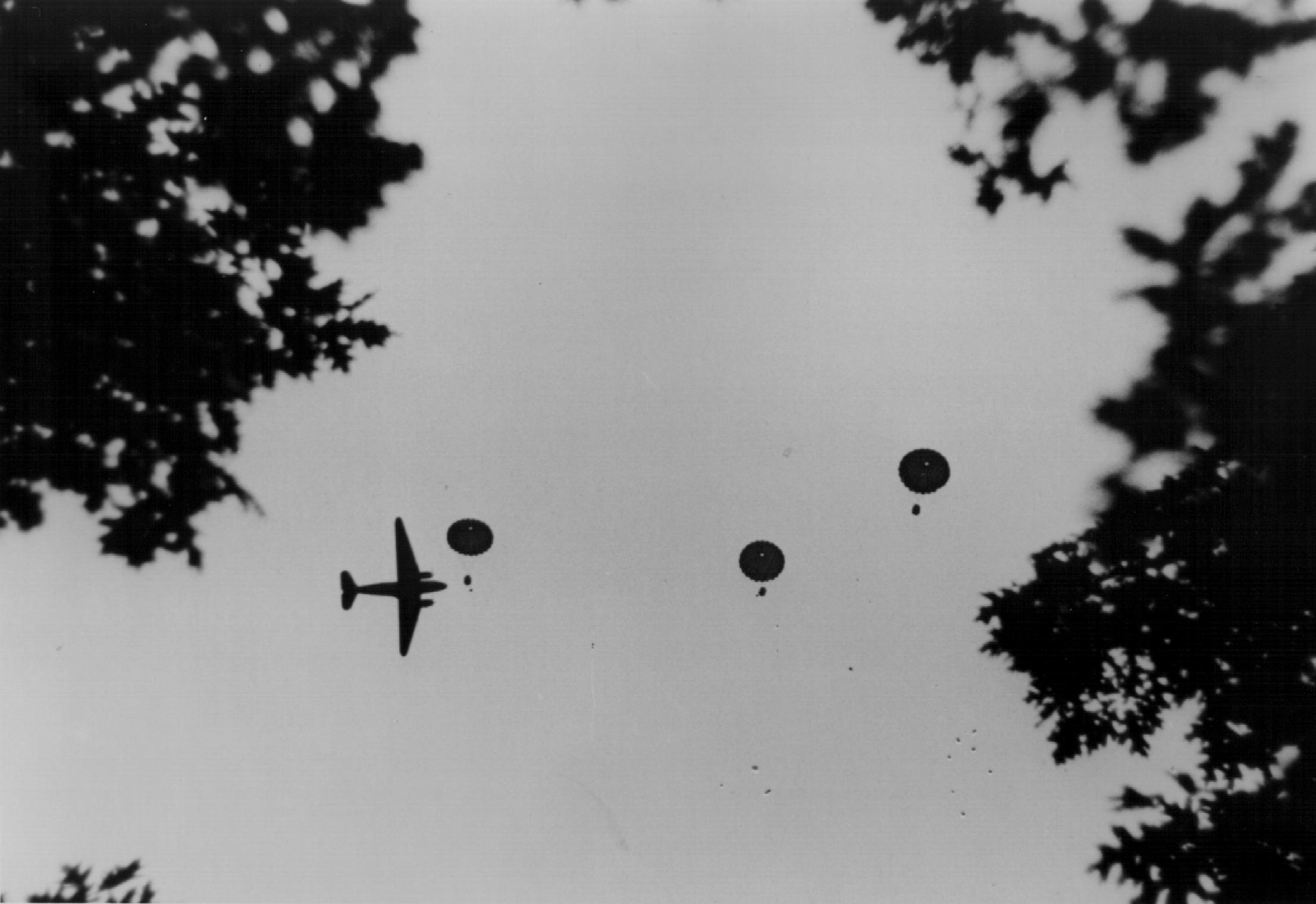
The largest airborne operation in history begins. Over 20,000 Allied paratroopers and glider troops land behind German lines in the Netherlands. The 1st Airborne Division drops near Arnhem, while American divisions secure bridges to the south.
Twin brother who ran through enemy fire to reach his wounded brother Tommy. Found lying side by side, they rest in adjacent graves at Oosterbeek. This database is dedicated to the Gronert twins.
Hit in the mouth by enemy fire at Oosterbeek Laag railway station, his cries for help drew his twin brother Claude to his side. They now rest in adjacent graves at Oosterbeek War Cemetery.

Lt. Col. Frost's men hold the north end of Arnhem Bridge against fierce German counterattacks. Relief forces struggle to break through. At Nijmegen and Eindhoven, American paratroopers fight to secure their objectives.
Wounded four times but refused evacuation. When a grenade landed among his comrades, he yelled 'grenade' and threw his body over it, sacrificing his life to save them.
Wounded while hunting German snipers, he was taken to a casualty station later overrun by SS troops. Witnesses believe he was murdered. His body was never found. He had said he would never be taken alive.
RAF pilots fly through heavy flak to resupply surrounded troops at Arnhem. Many drop zones are in German hands. The bridge defenders are running low on ammunition. Polish gliders bringing reinforcements are shot down.
His Dakota on fire, he ordered his crew to bail out while he continued the supply drop. He held the burning aircraft steady so the last man could jump, then went down with his plane over Arnhem.
Wounded in the face, then both arms, he reorganized his scattered company under heavy fire and personally led attacks on German positions. When cut off with a small party, he ordered his men to withdraw while he stayed behind alone with pistol and grenades to cover their escape. He was never seen again.
In a desperate gamble, American paratroopers cross the Waal River in canvas boats under withering fire. At Arnhem Bridge, the last defenders finally fall after four days. The perimeter at Oosterbeek shrinks.
Wounded in the shoulder on D-Day, again in the back on Day 3, he refused evacuation. On Day 4, he stood in full view of enemy tanks to direct his men's withdrawal. He was killed that night after four days of relentless fighting.
Crossed the Waal in the bow of his boat, firing his machine gun at German positions. When his gun was destroyed, he crawled within 15 yards of the enemy and destroyed their position with grenades before falling.
After four days of delays, the Polish Brigade finally drops at Driel, south of the Rhine. They land under fire in rapidly shrinking drop zones. The Oosterbeek perimeter contracts as German pressure intensifies.
Single-handedly stopped a German counterattack at Oosterhout. With his rocket launcher, he destroyed two tanks, killed nine Germans in a house with one round, then fell to a mortar shell while reloading.
At just 20, his Stirling bomber was attacked by German fighters after a supply drop. With his aircraft ablaze and heading toward the Dutch village of Batenburg, he deliberately steered away to crash into the River Meuse, saving hundreds of civilians. For 60 years, villagers have composed annual songs in his honor.
The Oosterbeek pocket becomes a desperate siege. Supplies dwindle. The wounded fill every house. Polish troops attempt night crossings of the Rhine to reinforce the perimeter, suffering heavy casualties.
Before the battle, he wrote: 'I loved you, Mom, you were the best Mother in the World... I want no flowers, no epitaph, no tears. All I want is for you to remember me and feel proud of me.' His farewell letter became famous.
An American from New Jersey who joined Polish Forces in 1940. At farm De Baarskamp, he moved forward to identify figures calling in English, wanting to prevent friendly fire. He was killed when a German attack suddenly began.
Polish troops continue desperate attempts to cross the Rhine and reinforce the British. Heavy casualties mount on both banks. In the corridor, American engineers race to build and defend vital bridges.
Led his engineers for 23 hours straight, building a critical bridge at Veghel under sniper fire. A Dutch engineer wrote: 'His calmness, especially in moments of danger, was remarkable.' He was killed by a sniper the next day.
Served under the name 'John P. Rodley' to hide his Jewish identity. Fighting against Nazi Germany, he carried the additional burden of knowing what capture might mean. His true name is now restored.
The decision is made to evacuate. Surviving troops prepare for withdrawal across the Rhine. In the perimeter, fighting continues house to house. The wounded who cannot be moved will be left behind.
An Irish immigrant, he attended Father Sampson's mass and told his buddies he had a feeling he wouldn't make it. They laughed it off. Two hours later, an 88mm shell took his life. 'All the men from his platoon cried.'
Murdered by SS-Sgt. Karl Lerche on the steps of the Municipal Hospital at Arnhem. A war crime that was documented and the perpetrator identified. Even hospitals offered no sanctuary.
Under cover of darkness and artillery, 2,400 survivors slip away across the Rhine. Canadian and British engineers ferry them in small boats. Many drown or are killed in the crossing. Over 6,000 are left behind.
Last seen rescuing his drowning commanding officer during the river crossing. His body was found in the Rhine weeks later. At just 19, he gave his life trying to save another. In 2003, his siblings finally visited his grave.
Operating Stormboat 1 to evacuate survivors, his boat took a direct mortar hit shortly after launching at 21:45. All four crew died instantly. His body was found in the river seven weeks later. He died trying to bring others home.
Go deeper into Operation Market Garden with detailed battlefield narratives, location photography, and historical context covering the entire operation—not just the nine days of combat.
Naast de militaire slachtoffers vielen er ook honderden burgers tijdens de Slag om Arnhem en omstreken. Ontdek hun verhalen in een eigen database met 640 geregistreerde personen.
In addition to military casualties, hundreds of civilians perished during the Battle of Arnhem. Explore their stories in a dedicated database of 640 registered persons. Dutch language only.
Search the Roll of Honour
Browse Profiles


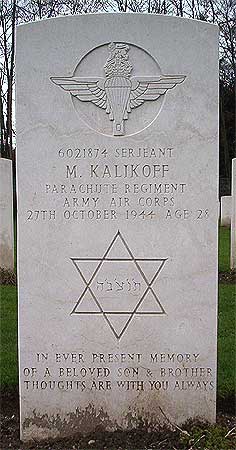
Sgt. Kalikoff had fled Ukraine as a child in the 1920's with his parents and sister and was very popular with the men despite being a strict disciplinarian and trainer. His mortar platoon had, together with elements of the Recce Squadron, reached and secured the northern end of the main Arnhem bridge, together with houses and buildings commanding the immediate area. With the other members of 2 Para Mortar Platoon, Sgt. Kalikoff dug individual slit trenches, surrounding two pits that were dug for the mortars, in an island of trees, shrubs and grass. in the centre of the road west of the road bridge. According to an account of James Simms (author of 'Arnhem Speearhead'): 'Just before Arnhem, Maurice had a bee in his bonnet about us achieving a quick exit and a tight stick, so he had us hobbling through a nissen hut with a kit bag on our leg and with full equipment. As this was early September, it was very hot and uncomfortable and we moaned a bit, but Maurice was determined we would get it right. Came the 17th Sept. 1944 and I had just landed by parachute and was gathering myself together to make for 2 Para yellow flare rallying point, when I met Maurice obviously searching for something. It turned out that his kit bag had broken free and he could not find it. I found this very amusing but he didn't. On the 20-09-1944 one of the houses Sgt. Kalikoff was in (close to the road bridge) recieved a direct hit, seriously wounding Kalikoff and killing. He died of his wounds probably on the way to a POW camp in Germany.